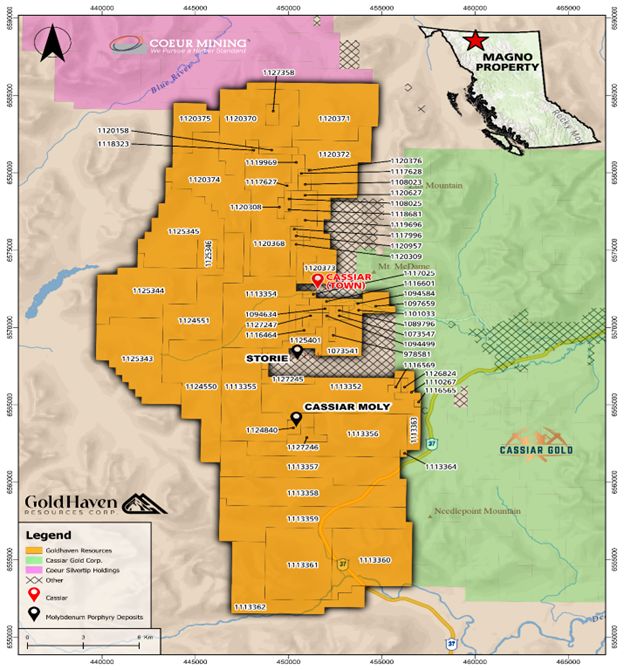
VANCOUVER, British Columbia, March 24, 2026 (GLOBE NEWSWIRE) -- GoldHaven Resources Corp. ("GoldHaven" or the "Company") (CSE: GOH) (OTCQB: GHVNF) (FSE: 4QS) has completed a review of historical exploration data from three recently acquired mineral claims within its Magno Project in the Cassiar District of northern British Columbia. The claims, which expanded the property to over 37,200 hectares, host three historically explored mineral occurrences — a tungsten-molybdenum skarn at Lamb Mountain, an intrusion-related molybdenum system at Cassiar Moly, and a polymetallic volcanogenic massive sulphide (VMS) occurrence at Lang Creek — collectively demonstrating multiple mineralization styles within the broader Magno property.
Highlights (Historical Data):
Historical drilling at Lamb Mountain returned tungsten and molybdenum mineralization, including 0.36% WO₃ over 24.9 m and trench results up to 1.65% MoS₂, highlighting a well-developed skarn system analogous to the nearby Kuhn and Dead Goat zones
Historical work at Cassiar Moly outlines a large-scale intrusion-related molybdenum system, with samples up to 14.50% MoS₂ and 0.49% W, supporting the presence of a fertile magmatic-hydrothermal system within the broader Magno district
Historical drilling by Cominco Ltd. at Lang Creek outlined a near-surface massive sulphide lens grading 1.52% Cu and 0.90% Zn, with associated gold and silver values
The Claims collectively demonstrate multiple mineralization styles (intrusion-related, skarn, and VMS) within a compact area, supporting GoldHaven’s interpretation of Magno as a district-scale, multi-phase polymetallic system
Several historically identified zones remain open or untested, including depth potential at Lang Creek, strike extensions at Lamb Mountain, and broader system-scale mineralization at Cassiar Moly
Management Commentary
Robert Birmingham, CEO of GoldHaven: “What makes these claims important is not a single result. The combination of skarn-hosted tungsten-molybdenum at Lamb Mountain, a large intrusion-related molybdenum system at Cassiar Moly, and VMS copper-zinc at Lang Creek, all within the same property boundary, continues to validate our geological thesis that the Magno district is driven by a large, multi-phase magmatic system capable of generating multiple styles of mineralization across a wide footprint.”
The Company cautions that all results described herein are historical in nature, have not been verified by a Qualified Person on behalf of GoldHaven, and should not be relied upon.
Overview
The Company has compiled and reviewed historical exploration data from the Lamb Mountain, Cassiar Moly, and Lang Creek occurrences, all of which form part of the broader Magno Project. These data, derived from BC MINFILE records and historical assessment reports, highlight the presence of multiple mineralization styles within the same district, including tungsten-molybdenum skarns, intrusion-related molybdenum systems, and polymetallic VMS mineralization.
GoldHaven believes this combination supports the interpretation of Magno as a fertile, district-scale polymetallic system with potential to host both critical minerals and base/precious metals.
The Company cautions that all results described herein are historical in nature, have not been verified by a Qualified Person on behalf of GoldHaven, and should not be relied upon.
Lamb Mountain – Tungsten-Molybdenum Skarn Corridor (Historical Data)
The Lamb Mountain occurrence is described in historical reports as a tungsten-molybdenum skarn system developed along the contact between intrusive rocks and carbonate units, with mineralization traced over at least 330 metres.
Historical results include:
Diamond drilling reporting:
0.36% WO₃ over 24.9 m (including 0.49% WO₃ over 16.7 m)
0.83% MoS₂ over 12.8 m
Trenching results reporting:
Up to 1.65% MoS₂ over 4.0 m
Tungsten values averaging 0.70% WO₃ over 10 m, with selected samples up to 2.20% WO₃
Soil geochemistry outlining anomalous tungsten and molybdenum over several hundred metres.
Lamb Mountain is interpreted to form part of a broader tungsten-molybdenum skarn corridor within the Magno Project, consistent with mineralization observed at the Kuhn and Dead Goat zones. This clustering supports the potential for district-scale skarn development associated with a common intrusive source.
Tungsten is classified as a critical mineral by both the Government of Canada and the US Department of the Interior. Canada currently has no primary domestic tungsten production.
Cassiar Moly – Intrusion-Related System (Historical Data)
The Cassiar Moly occurrence is described in historical reports as a molybdenum-bearing system hosted within a quartz monzonite intrusion, covering approximately 2.5 square kilometres.
Historical exploration includes:
Surface sampling reporting:
Up to 14.50% MoS₂ and 0.49% W
Additional samples exceeding 2%–4% MoS₂
Underground sampling reporting:
4.17% MoS₂ over 1 m
1.64% MoS₂ over 3 m
Diamond drilling intersecting broad intervals of mineralization, including:
Up to 164.6 m averaging approximately 0.024% Mo
The scale of the Cassiar Moly intrusion (approximately 2.5 square kilometres), combined with its proximity to skarn mineralization at Lamb Mountain, Kuhn, and Dead Goat, is consistent with a system where a common intrusive source drives both skarn and stockwork-style mineralization across the broader Magno property.
Lang Creek – Polymetallic VMS Occurrence (Historical Data)
The Lang Creek occurrence is described in historical reports as a Cyprus-type volcanogenic massive sulphide (VMS) system hosted within the Sylvester Group.
Historical work by Cominco Ltd. reported a historical estimate of 27,000 tonnes grading 1.52% copper and 0.90% zinc at the Lang Creek occurrence. The source of this estimate is [identify source report and date]. The estimate was prepared prior to the implementation of NI 43-101 and does not use current CIM Definition Standards for mineral resources and mineral reserves. A Qualified Person has not done sufficient work to classify this historical estimate as a current mineral resource or mineral reserve. GoldHaven is not treating this historical estimate as a current mineral resource or mineral reserve.
Historical exploration includes:
Diamond drilling by Cominco Ltd. reporting a near-surface sulphide lens with a historical estimate of:
27,000 tonnes grading 1.52% Cu and 0.90% Zn
Surface sampling reporting:
1.7 g/t Au, 36 g/t Ag, 1.84% Cu across 1.0 metre
Additional mineralization indicators along strike and untested conductive zones
Lang Creek highlights the presence of polymetallic VMS-style mineralization within the Magno district, representing an additional mineralization style complementary to skarn and intrusion-related systems.
District-Scale Implications for Magno
The combination of tungsten-molybdenum skarns (Lamb Mountain, Kuhn, Dead Goat), intrusion-related molybdenum systems (Cassiar Moly), and polymetallic VMS mineralization (Lang Creek) supports GoldHaven’s interpretation of Magno as a district-scale, multi-phase mineral system.
About GoldHaven Resources Corp.
GoldHaven Resources Corp. is a Canadian junior exploration Company focused on acquiring and exploring highly prospective land packages in North and South America. The Company’s projects include the flagship Magno Project, a district-scale polymetallic property adjacent to the historic Cassiar mining district in British Columbia. The Three Guardsman Project, which exhibits significant potential for copper and gold-skarn mineralization. The Copeçal Gold Project, a drill-ready gold project located in Mato Grosso, Brazil with a 6km strike of anomalous gold in soil samples. Three Critical Mineral projects with extensive tenement packages totaling 123,900 hectares: Bahia South, Bahia North and Iguatu projects located in Brazil.
On Behalf of the Board of Directors
Rob Birmingham, Chief Executive Officer
For further information, please contact:
Rob Birmingham, CEO
www.GoldHavenresources.com
info@goldhavenresources.com
Office Direct: (604) 629-8254
Qualified Person:
The technical and scientific information contained in this news release has been reviewed and approved by Raymond Wladichuk P.Geo. who is a non-independent Qualified Person as defined under NI 43-101 and a consultant of the Company.